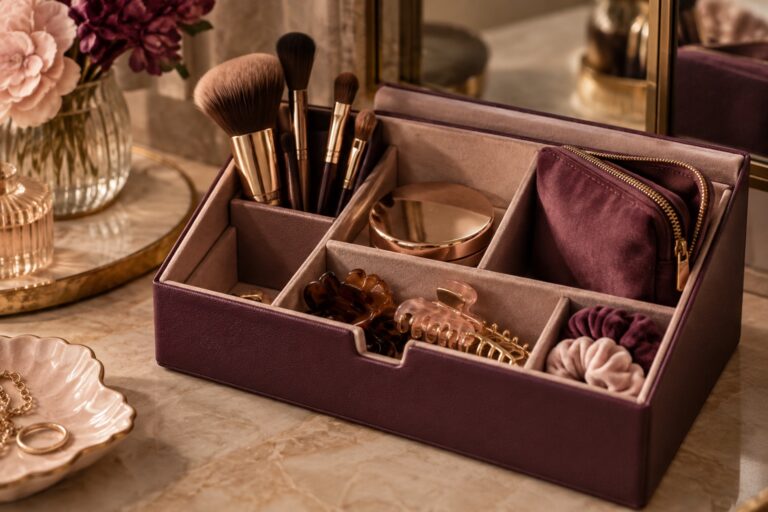
AI-created editorial photo. Not the specific reviewed product.
A useful organizer should make your existing space easier to use. Start with the location where it will live, not a photo of an empty container. A few measurements and a simple sketch can reveal whether you need a new case, a smaller tray or a different arrangement of the things you already own.
Mark the usable space
Draw the shelf, drawer or counter from above and note its usable width and depth. Measure between real obstructions, including drawer runners, a mirror stand or the edge of a nearby cabinet. Add height where something sits above the storage area. Keep units visible beside every number.
Separate the place where the organizer is stored from the place where you will use it. A case kept on a shelf may be carried to a table before opening. If you expect to use it inside the shelf, the lid and trays need space there as well.
Compare like measurements
Use product dimensions rather than shipping-carton dimensions. Record whether the listed numbers are external, internal or unclear. Do not assign width, depth and height to an unlabeled sequence because the order looks familiar. Ask the seller or manufacturer when the distinction changes your decision.
For an illustrative shelf that is 34 centimeters wide, 24 deep and 30 high, a closed case listed as 30 wide, 20 deep and 25 high leaves differences of 4, 4 and 5 centimeters. Those differences do not prove the lid opens, the handle clears or your fingers can reach the zipper. Treat the calculation as a first filter.
Test the movement, not just the rectangle
Sketch the extra space used by a lid, sliding tray or drawer when open. Consider how you will lift out a bottle or pull a brush from a compartment. A paper outline can help visualize a footprint, but it cannot establish hinge travel, flexibility or the actual interior.
Place your awkward items beside the sketch: the longest brush, widest palette and tallest container. Write their measurements down with any limits on how they can be stored. Do not assume an item can be tilted or laid down simply because that makes the diagram work.
Finish with a short decision note
Record what is confirmed, what is missing and what would make you reject the option. For example: exterior fits, opening clearance unknown, longest palette needs an internal measurement. This turns an attractive listing into a manageable question rather than a guess.
Try reorganizing the current space before buying. Move a rarely used group elsewhere or remove duplicate storage that blocks access. If a new organizer still solves a clear problem, you will have a measured reason for choosing it and a practical check to perform when it arrives.
Read next
Beauty Kit Organization: Match the Product to the Missing Job